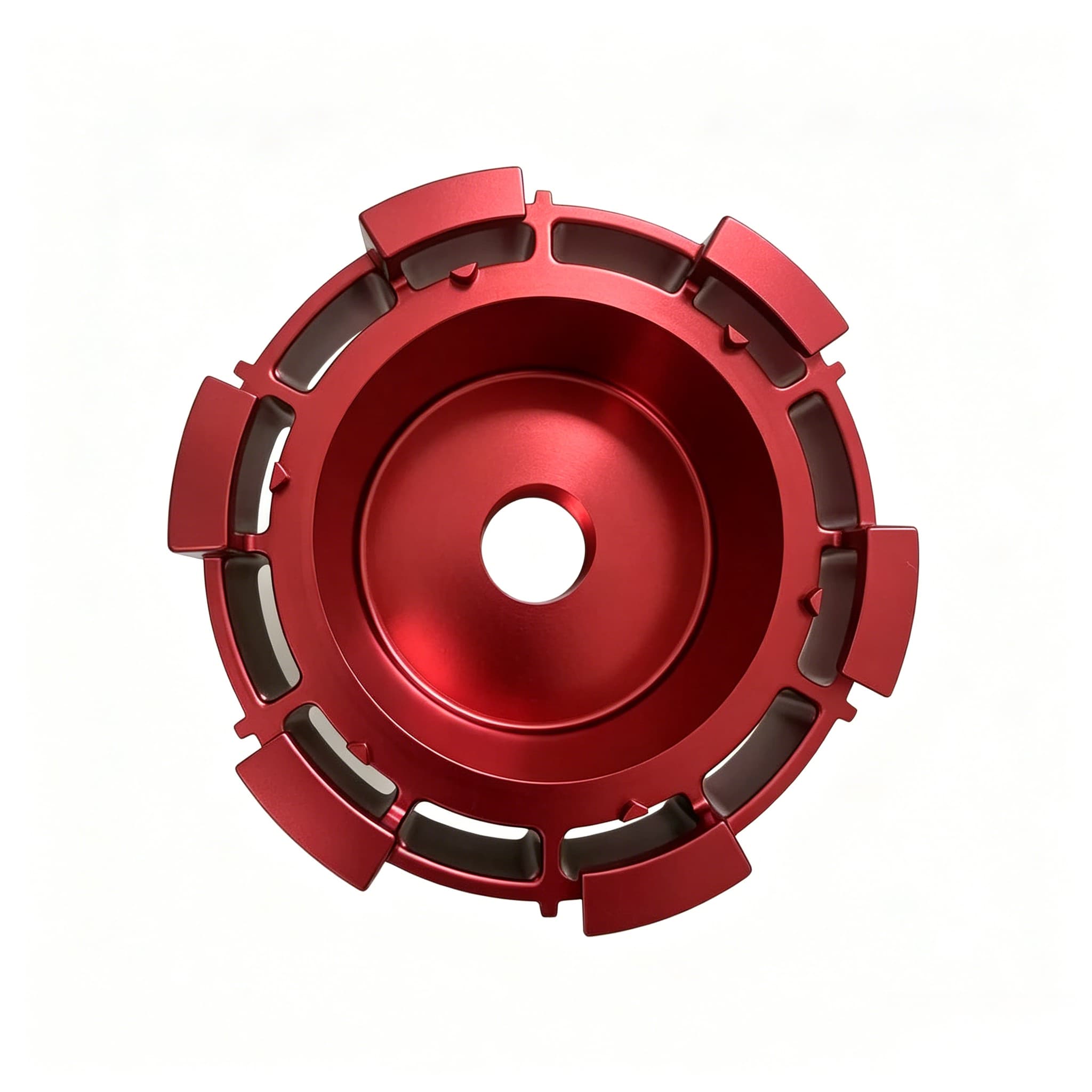
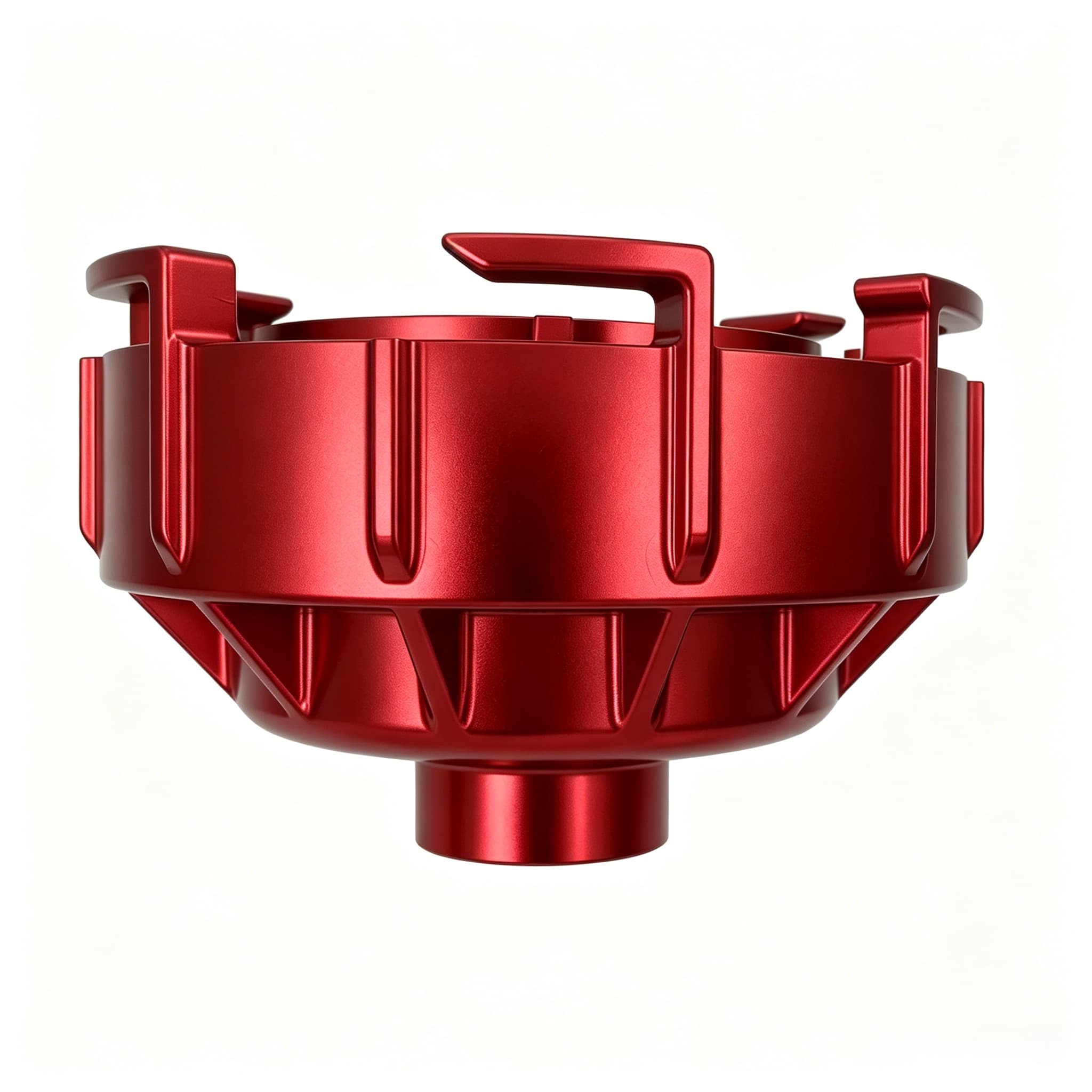
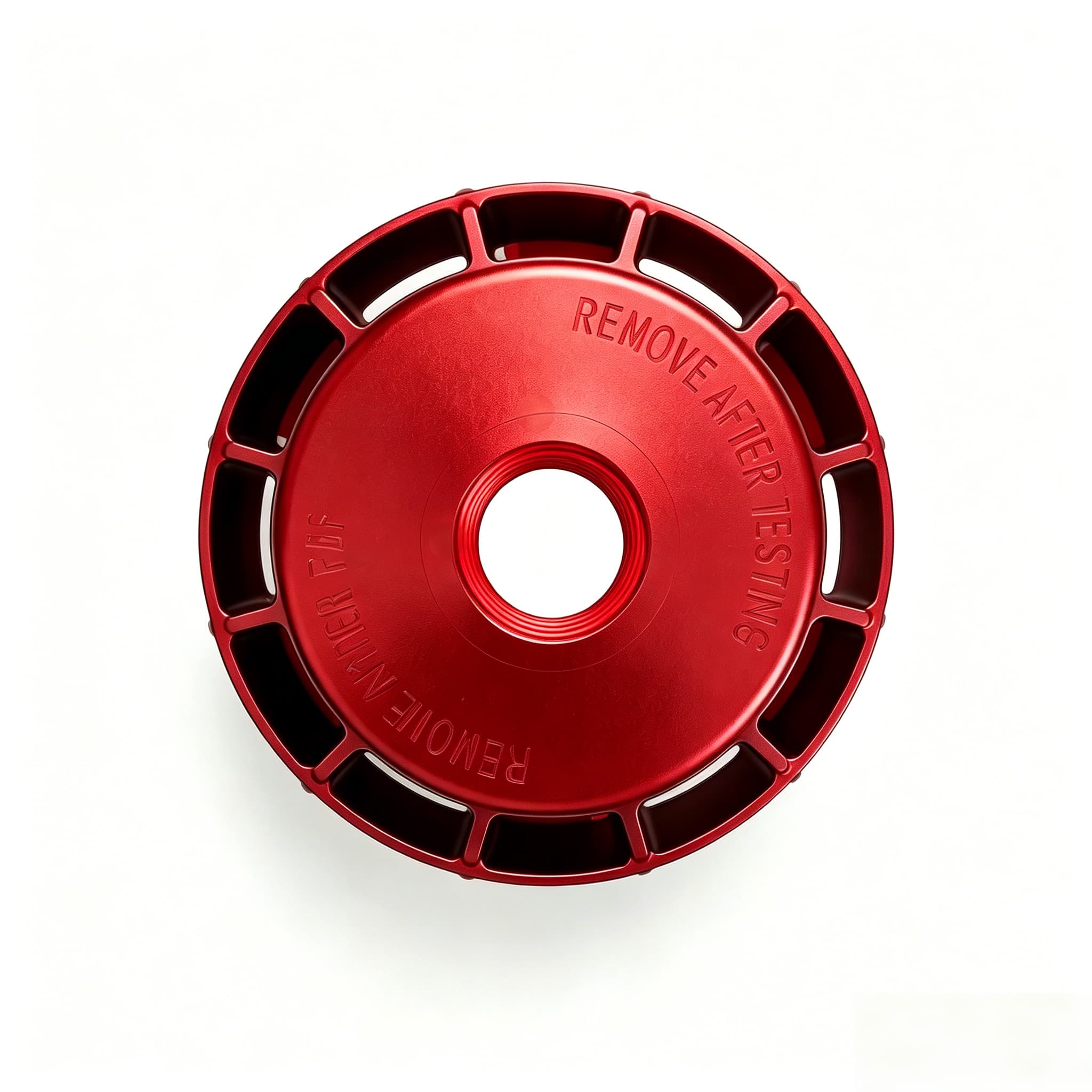
Machined from high-grade 6061-T6 aluminum with a durable red hard anodized finish, the custom component shown is a precision quick-release test fixture. It is widely applied to new energy
battery testing lines, semiconductor manufacturing equipment and industrial automation assembly stations worldwide.
This fixture features symmetric locking tabs, a stepped internal cavity, a concentric center bore and laser-etched marking "REMOVE AFTER TESTING". It requires stable dimensional accuracy,
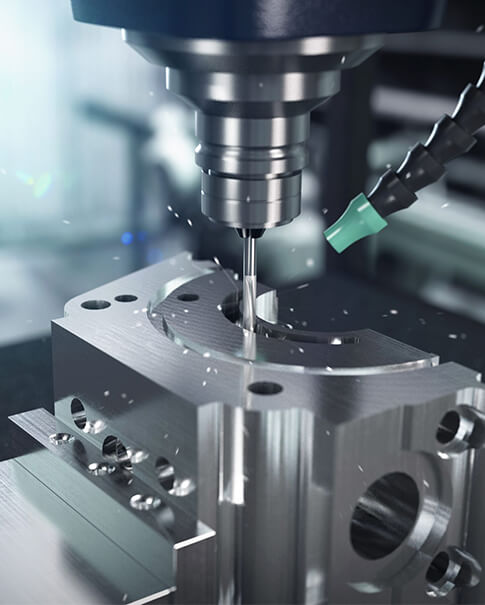
reliable clamping performance and long-term wear resistance. For industrial engineers and procurement teams, selecting proper 3-axis, 4-axis or 5-axis CNC machining directly determines product quality,
production cost and delivery schedule. This practical case study will help you pick the most suitable CNC solution for similar precision components.
Although the fixture looks structurally simple, its special geometry and strict tolerance bring multiple universal difficulties in precision CNC production:
· Eight symmetric locking tabs: Requires tight positional tolerance (±0.02 mm) and uniform height. Minor deviations will cause uneven clamping force and affect the stability of the entire production line.
· Stepped internal cavity & concentric center bore: Demands high concentricity control (≤ 0.01 mm between center bore and bottom journal).
· Undercut profiles on locking tabs: Cannot be fully processed by standard straight cutting tools in a single clamping operation.
· Red hard anodized surface: Must be uniform and burr-free without visible tool marks. Extensive manual deburring is prohibited, as it will cause dimensional errors.
For mass production, traditional machining methods will lead to high scrap rates, prolonged lead times and rising labor costs due to repeated clamping and manual finishing.
The table below summarizes core performance data based on our actual production of 100 identical fixtures, following international GD&T standards for your intuitive reference.
|
Comparison Dimension |
3-Axis CNC Machining |
4-Axis CNC Machining |
5-Axis CNC Machining |
|
Total Setups & Fixtures |
3 setups + 1 auxiliary fixture |
2 setups (top/side + bottom flipping) |
1 single setup |
|
Machining Cycle Time (per piece) |
18–22 minutes |
10–12 minutes |
8–9 minutes |
|
Bore-to-Shaft Concentricity |
±0.02–0.03 mm |
±0.01–0.015 mm |
±0.005–0.008 mm |
|
Locking Tab Position Tolerance |
±0.03–0.05 mm (setup deviation risk) |
±0.015–0.02 mm |
±0.01 mm |
|
Surface Roughness (Ra, undercut area) |
1.6–3.2 μm (needs hand finishing) |
0.8–1.6 μm |
≤ 0.8 μm (completely burr-free) |
|
Secondary Manual Work |
Heavy deburring required |
Only occasional touch-up |
No secondary work needed |
|
Scrap Rate (100-piece batch) |
8–12% |
2–4% |
<0.5% |
As shown above, 3-axis machining is limited by repeated clamping and poor surface quality for undercut features. 4-axis CNC machining delivers the best balance between cost and performance.
5-axis CNC machining achieves the highest precision, surface finish and production consistency with zero rework.
When adopting 3-axis CNC equipment, the whole production process needs three independent clamping steps: first machine the bottom shaft and center bore from aluminum blanks;
flip and re-fixture the part to process the top surface and stepped cavity; finally use a custom angle fixture to machine the undercut locking tabs.
Repeated clamping inevitably produces cumulative positioning errors. While 3-axis machines have a lower hourly operating cost, extra fixture fees, labor costs and high scrap rate will offset the price advantage.
Tool marks on undercut areas also require a large amount of manual deburring, which further damages dimensional consistency. This solution is only recommended for small prototype orders (1–5 pieces) with low precision requirements, and cannot meet the repeatability standards of medium and large batch custom CNC parts.
4-axis CNC machining adds a rotary axis based on 3-axis equipment, which solves most processing pain points of this test fixture. The workpiece is mounted on a rotary indexer,
so the top surface, internal cavity and all eight locking tabs can be completed in one continuous process, eliminating the need for extra auxiliary fixtures.
The rotary structure allows cutting tools to approach undercut profiles at the optimal angle, reducing tool wear and improving surface finish.
Only one extra clamping is needed to flip the part and machine the bottom shaft, which greatly reduces cumulative errors. With moderate operating cost,
stable cycle time and controllable scrap rate, 4-axis machining is the most cost-effective choice for orders of 20–200 pieces, and has become the mainstream solution for European and American industrial clients.
5-axis CNC machining is equipped with two rotary axes, enabling one-clamp full processing for this complex fixture. All features including undercut tabs,
deep cavities and bottom shafts can be completed without re-fixturing, thoroughly eliminating positioning errors caused by repeated operations.
The center bore and bottom shaft maintain excellent concentricity, and all locking tabs keep uniform height.
During cutting, the tool always stays perpendicular to the workpiece surface, suppressing vibration and creating a smooth, burr-free surface that requires no manual work.
Although the hourly rate of 5-axis equipment is higher, the shortened cycle time, near-zero scrap rate and eliminated secondary work greatly reduce the total production cost for medium and large batches.
For high-precision requirements or orders over 200 pieces, 5-axis machining is the most reliable option for CNC machined parts.
You can select the optimal machining solution according to your order quantity, precision tolerance, budget and project timeline.
|
Decision Factor |
Recommended Solution |
Core Reason |
|
1–5 prototypes, tight budget, tolerance ≥±0.03 mm |
3-Axis CNC Machining |
Low upfront cost; manual finishing is acceptable for small test runs |
|
20–200 pieces, standard industrial tolerance (±0.015 mm) |
4-Axis CNC Machining |
Best cost-performance ratio; low scrap rate and few reworks |
|
200+ pieces, strict concentricity (≤±0.01 mm), no manual work allowed |
5-Axis CNC Machining |
Minimize scrap, shorten lead time and cut long-term comprehensive cost |
At our ISO 9001 certified factory, we adopt a hybrid production mode for this test fixture. Standard orders use 4-axis machining to balance cost and quality,
while high-precision and large-batch orders are arranged on 5-axis equipment to meet strict industrial standards.
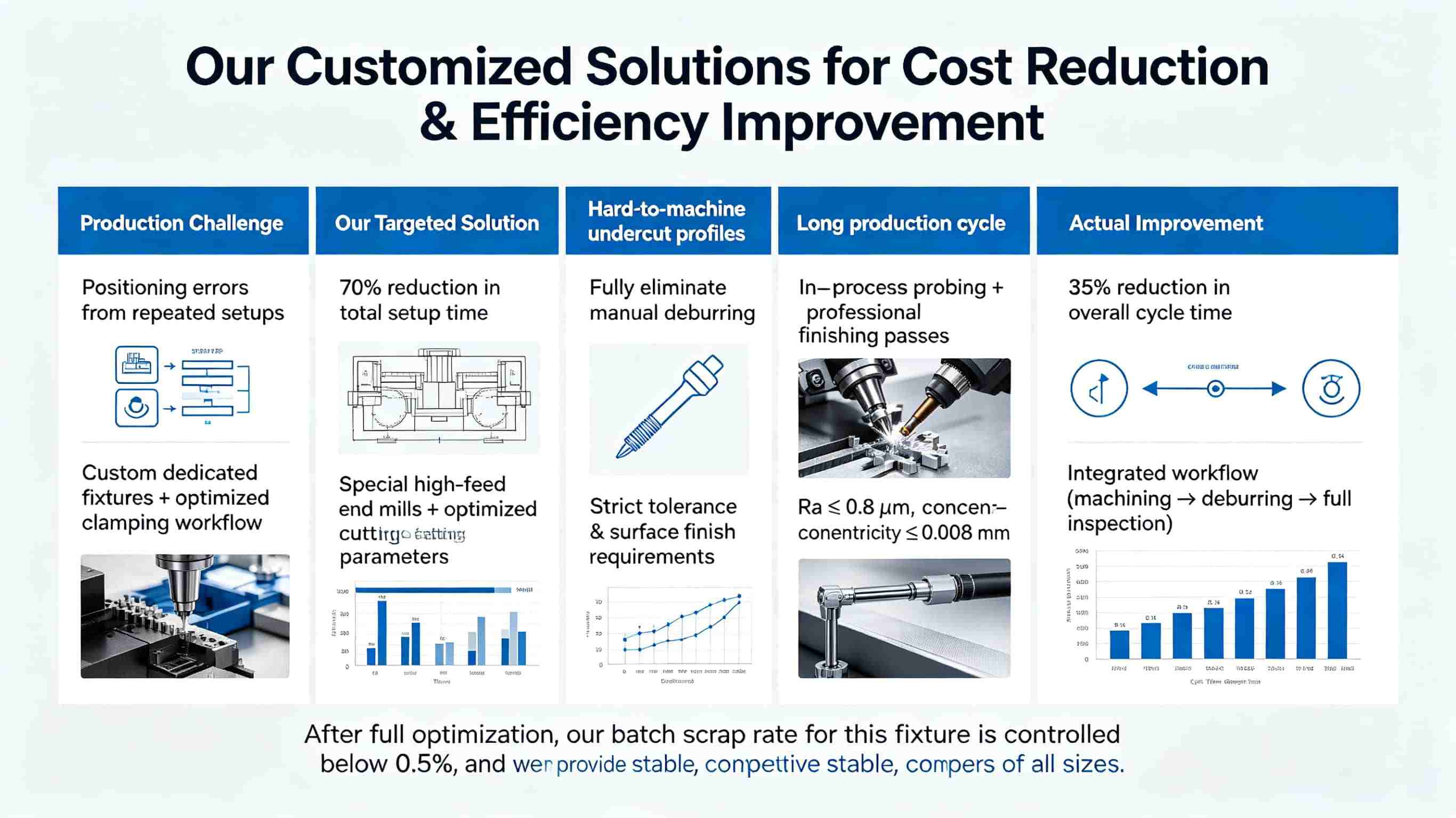
Aiming at the inherent processing difficulties of this precision fixture, we have developed a set of mature optimized processes, with clear solutions and measurable results as below:
|
Production Challenge |
Our Targeted Solution |
Actual Improvement |
|
Positioning errors from repeated setups |
Custom dedicated fixtures + optimized clamping workflow |
70% reduction in total setup time |
|
Hard-to-machine undercut profiles |
Special high-feed end mills + optimized cutting parameters |
Fully eliminate manual deburring |
|
Strict tolerance & surface finish requirements |
In-process probing + professional finishing passes |
Ra ≤ 0.8 μm, concentricity ≤ 0.008 mm |
|
Long production cycle |
Integrated workflow (machining → deburring → full inspection) |
35% reduction in overall cycle time |
After full optimization, our batch scrap rate for this fixture is controlled below 0.5%, and we can provide stable, competitive pricing for orders of all sizes.
Compared with local CNC suppliers in the US, UK, Germany and other European countries, our factory has comprehensive strengths for manufacturing this type of precision component:
2. Flexible multi-axis production capacity: Our complete fleet of 4-axis and 5-axis CNC machines supports flexible scheduling, effectively avoiding order backlogs and long lead times that commonly trouble Western local workshops.
3. Rich project experience: We have over a decade of experience in manufacturing complex precision CNC components for global clients, and our engineering team is skilled in optimizing processes for undercuts, deep cavities and tight tolerances.
4. One-stop full service: We provide DFM review, CNC machining, surface treatment, inspection and shipping in-house, helping you simplify procurement and shorten the overall project cycle.
All production procedures comply with the ISO 9001:2015 quality management system. Every finished fixture will undergo full dimensional inspection via CMM coordinate measuring machines before delivery. We provide complete compliance documents for every order, including:
· Material certificates (EN 10204 Type 3.1)
· CMM dimensional inspection reports
· Laser marking verification records
Our English-speaking engineering and sales team provides timely technical consultation, order progress tracking and after-sales support,
adapting to the working hours of European and American clients. We also sign formal NDA agreements for all customized projects to fully protect your intellectual property and design data.
From raw aluminum blanks to finished red hard anodized fixtures, every link of 3-axis, 4-axis and 5-axis CNC machining determines the final quality,
cost and delivery performance. 3-axis machining suits low-volume prototype projects; 4-axis is the optimal choice for most standard production orders;
5-axis delivers top-level precision and consistency for high-standard mass production.
With mature multi-axis processing technology, strict quality control, competitive pricing and fast delivery,
we have become a trusted long-term partner for numerous industrial enterprises across North America and Europe.
Whether you need a single prototype, small-batch trial production or large-scale mass production, we can provide tailored CNC solutions for your custom parts.
✅ Ready to start your project? Send your CAD files (STEP/IGS) and 2D engineering drawings to us, and you will receive a free DFM review and formal quotation within 24 hours. You can also upload files directly via our official website: [your-website.com/upload]
We look forward to cooperating with you and making your CNC project a success.
Tel : 0755-23596843
WhatsApp : +86-13267211181
Email : sales02@gt-proto.com
No.18, Shaqi Community Center Road, Xinqiao Street, Baoan District, Shenzhen, Guangdong Province, China 518104
© 2026 Shenzhen GT Prototype Co., Ltd All rights reserved.
SitemapPrivacy PolicyXml